


- True handleless cabinets use a recessed rail, J-pull edge, or push-to-open hardware so the door front stays visually clear.
- Integrated-pull cabinets still have a built-in gripping channel; they are not the same as touch-latch doors.
- Black handles on grey cabinets are often the safer choice for busy kitchens because the pull point is obvious and easy to service.
- US buyers should confirm cabinet dimensions, panel compliance, drawer hardware, shipment format, and assembly checks before placing a bulk order.
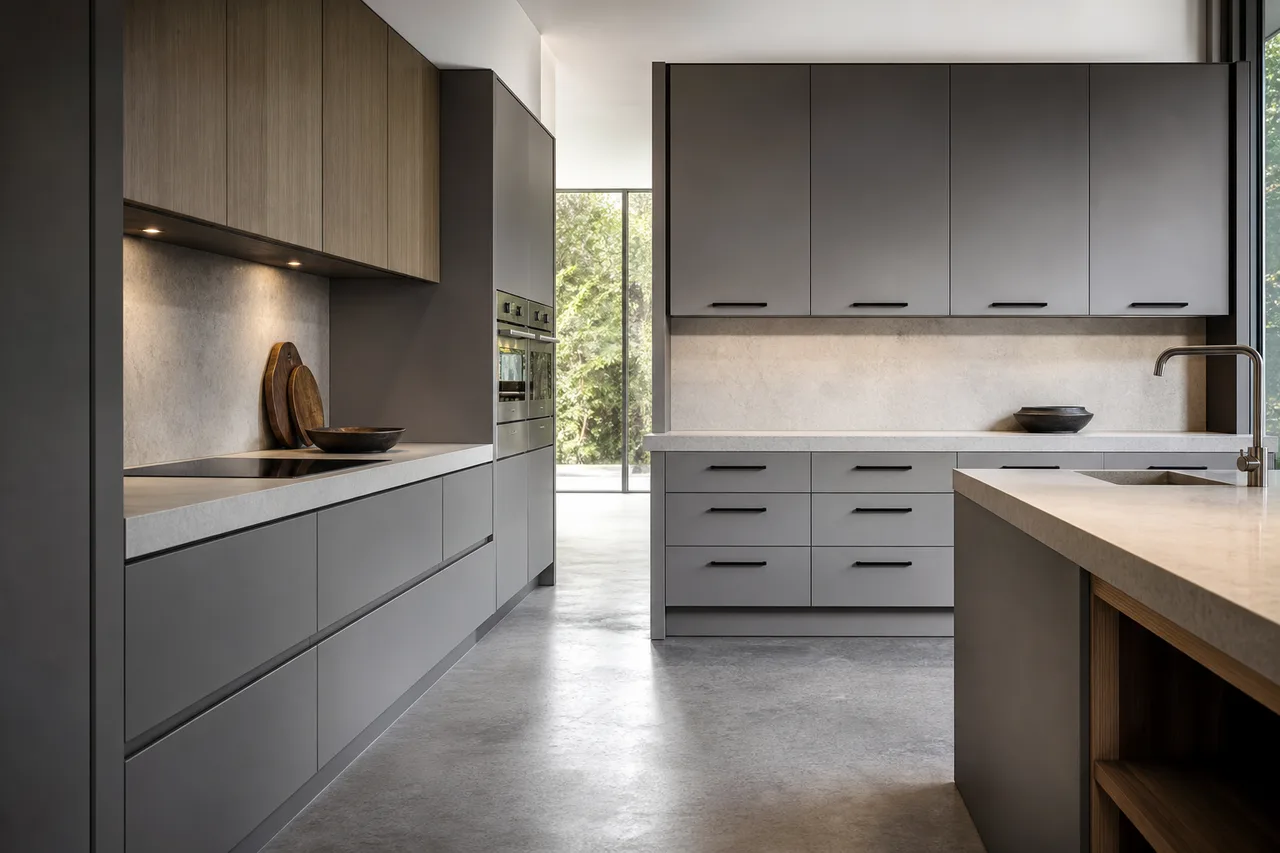
Key Takeaways: Choose True Handleless Cabinets for a Seamless Look, or Black Handles on Grey Cabinets for Visible Contrast
A handless kitchen cabinet is defined by how you open it, not simply by the absence of a decorative knob. The door may have a J-shaped lip, a recessed aluminum rail, an integrated finger channel, or a push-to-open latch. Those systems create very different results in daily use.
True handleless cabinetry gives a clean, uninterrupted front. It suits modern apartments, compact kitchens, and projects where the cabinet run is meant to read as one plane. The trade-off is practical: recessed channels collect crumbs, push latches need adjustment, and some users find a mechanical pull more comfortable than pressing a door with wet or greasy hands.
J&S Household’s latest direction, black handles on grey cabinets, takes the opposite approach. The grey cabinetry keeps the room restrained, while the black pull provides a clear contact point and a strong visual grid. For rental housing, contractor-led remodels, and family kitchens, that visibility can matter more than a completely uninterrupted door front.
Handless Kitchen Cabinet FAQ: What Is the Difference Between Handleless and Integrated-Pull Cabinets? Are J-Pull and Gola Profiles the Same? When Are Black Handles on Grey Cabinets a Better Choice?
What is the difference between handleless and integrated-pull cabinets?
Handleless cabinets use an opening method built into the cabinet construction or hardware. Integrated-pull cabinets have a gripping recess or channel formed into the door or fitted between cabinet fronts. Both avoid a separate knob, but an integrated pull still gives your fingers a defined edge. A touch-latch door has no grip profile at all; it opens when you press the front and the latch releases.
Are J-pull and Gola profiles the same?
No. A J-pull is usually shaped into the cabinet door edge, creating a J-like recess that you can catch with your fingers. A Gola system normally uses a horizontal or vertical aluminum profile installed into the cabinet structure, leaving a continuous channel between doors and drawers. The exact profile, clearance, and installation method vary by supplier, so request a section drawing rather than relying on the name alone.
When are black handles on grey cabinets a better choice?
Visible black handles are a sound choice when several people will use the kitchen, when maintenance teams need quick access, or when the project prioritizes predictable operation over a completely flat front. They also help break up a large grey cabinet wall. The main downside is that the handles must be aligned carefully; inconsistent drilling is noticeable from across the room.
Handleless Cabinet Opening Systems Compared: J-Pull, Gola Profile, Integrated Pull, Touch Latch, and Visible Black Handles
Buyers often compare these systems by appearance alone. That is a mistake. The opening method affects door clearance, cleaning, replacement parts, installation time, and how easily a cabinet can be used with one hand.
| Opening system | Strengths | Points to check |
|---|---|---|
| J-pull | Simple visual treatment with a built-in finger recess | Door-edge clearance, grip comfort, and cleaning in the recess |
| Gola profile | Continuous horizontal or vertical lines across a cabinet run | Profile cost, corner details, installation accuracy, and replacement access |
| Integrated pull | A defined grip without an added external handle | Door construction, edge durability, and whether the recess suits your hand |
| Touch latch | Very clean front with no visible pull | Latch adjustment, press force, spring life, and accidental opening |
| Visible black handle | Easy to locate, operate, and replace | Hole position, screw fixing, alignment, and finish durability |
For a US project, also ask how the system works on tall pantry doors, integrated appliances, corner units, and wide drawers. A design that works on a 24-inch base cabinet may feel awkward on a full-height door. Ask for hardware samples or a test cabinet before approving a large run.
How US Buyers Should Specify Handless Kitchen Cabinets for Residential, Remodeling, and Multi-Unit Projects
Start with the room, not the finish board. Provide the wall lengths, ceiling height, appliance locations, sink position, plumbing constraints, and any filler requirements. For remodeling work, note which walls are out of square. A cabinet plan can be dimensionally correct and still fail during installation if the installer has no allowance for uneven drywall or an exposed end panel.
J&S Household supplies custom kitchen cabinets, flat-pack kitchen units, loose panels, and assembled cabinetry. That gives contractors and distributors different ways to manage freight and labor, but the shipping format must be agreed before production. Flat-pack units reduce shipping volume and may lower handling costs; assembled cabinets can reduce site labor but need more careful protection and access planning.
- Send a dimensioned plan with appliance specifications and desired opening system.
- Confirm door material, color reference, edge treatment, cabinet box construction, and exposed-side requirements.
- Specify drawer slide systems, lift-up hardware, storage accessories, and soft-closing requirements where needed.
- Approve shop drawings, finish samples, and the placement of handles or profile channels.
- Request test assembly and inspect alignment, clearances, and hardware operation before bulk shipment.
For US housing projects, ask for documentation on panel standards. J&S states that E1 or CARB-2 compliant panel options are available, along with quality-system and testing references including ISO9001, SGS, CNAS, and CQC. Confirm which documentation applies to the exact material and order rather than assuming every panel has the same declaration.
Door Finishes, Hardware, Storage, and Care Requirements for Modern Handleless Kitchens
Handleless design puts more attention on the door surface, so finish selection matters. J&S Household lists thermofoil, lacquer, melamine, and acrylic kitchen-door categories. Thermofoil is practical for consistent color and formed details. Lacquer offers a coated appearance but can show scratches and impact marks. Melamine is widely used for repeatable, durable cabinet surfaces. Acrylic can provide a stronger visual depth, though buyers should still confirm edge construction and cleaning instructions.
Grey cabinetry with black handles is forgiving from a planning standpoint, but not from an installation standpoint. Use a drilling template and keep the handle centerline consistent across doors and drawers. On integrated-pull or Gola systems, inspect the channel at corners and end panels; small mismatches become obvious where profiles meet.
Storage hardware also affects the real value of a handleless kitchen. Ask about drawer slide capacity and adjustment, lift-up systems for wall cabinets, pull-outs, tray storage, waste sorting, and access around plumbing. A clean front does not compensate for a drawer that sags under cookware.
Care is straightforward: use a soft cloth, mild detergent, and limited water. Avoid abrasive pads, solvent cleaners, and standing moisture at door edges or profile channels. Push latches and sliding profiles should be kept free of grit. If a touch latch begins opening inconsistently, adjust or replace the hardware rather than forcing the door, which can damage the front or hinge settings.
Source Custom or Flat-Pack Cabinets From J&S Household: Custom Sizing, Test Assembly, E1 or CARB-2 Panel Options, Bulk Shipping, and 5-Year Warranty — Request a Quote at https://www.jscabinet.com/black-handles-on-grey-cabinets.html
J&S Household manufactures and supplies kitchen cabinetry, cabinet doors, flat-pack units, wardrobes, bathroom vanities, kitchen hardware, and interior and entrance doors. Its customer base includes homeowners, contractors, designers, builders, developers, wholesalers, retailers, distributors, and global housing-project partners serving the US market.
For a handless kitchen cabinet program, send the supplier more than a room sketch. Include the preferred opening method, finish, cabinet list, appliance schedule, shipment format, installation responsibility, and required compliance documents. If you are considering the black-handle grey-cabinet collection, ask for finish samples and handle placement drawings before approving production.
J&S states that it can support custom dimensions, test assembly, bulk orders, E1 or CARB-2 compliant panel options, and a stated five-year warranty. Confirm the warranty scope, exclusions, claim process, lead time, packaging standard, and replacement-hardware policy in the quotation. Those details matter after installation, especially for multi-unit projects.
Request a Cabinet Quote From J&S Household
Send your plans, cabinet schedule, preferred handleless or black-handle design, finish requirements, and shipment format to confirm sizing, materials, hardware, test assembly, and bulk-order terms.
Visit Official Website →