


Ask what you are actually buying, which door surface fits the intended market, what the quotation includes, and how the supplier checks fit before packing. A China kitchen cabinet door order can be straightforward, but vague requests create expensive problems: a replacement panel that misses an existing drill pattern, an unpriced edge treatment, or loose doors packed for a route they cannot survive.
J&S Household supplies cabinet doors alongside custom cabinets, flat-pack units, hardware, and interior products for trade and project buyers. Before asking for a price, give the supplier a usable brief: door type, drawings or samples, quantities, destination, packing preference, and whether you need doors only or a full cabinet package.
First, Are You Sourcing Replacement Doors, Custom Cabinets, or a Flat-Pack Project Package?
Start with the buying scenario, because it changes almost every question that follows. Replacement kitchen cabinet doors need to match an existing cabinet box. That means the supplier needs the finished door dimensions, opening direction, hinge cup and mounting requirements, handle drilling if applicable, edge treatment, and a clear view of the current colour and surface. “White shaker door” is not enough to reproduce a door reliably.
A custom kitchen project is broader. Confirm who owns the final cabinet layout, door schedule, hardware specification, and room-by-room approval process. Builders and developers should also establish how revisions are controlled after drawings are released; late changes to a single unit can affect packing lists and installation sequencing across a larger order.
For a flat-pack program, the priority is repeatability. Ask how door panels, cabinet components, hardware, labels, and instructions will be grouped for picking and installation. J&S Household lists both loose-panel and assembled shipment, so it is sensible to discuss the assembly model before quoting a flat-pack kitchen unit program.
Which Kitchen Cabinet Door Surface Should You Compare for Your Buyer Segment?
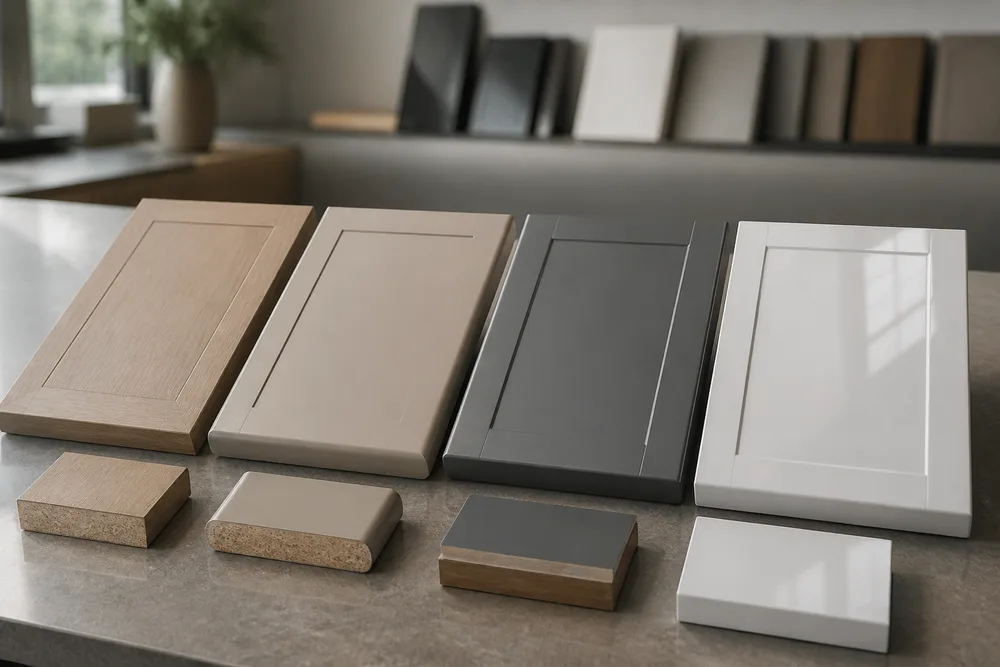
Compare the surface against the buyer’s budget, expected visual standard, cleaning habits, and repair tolerance—not against a showroom sample alone. J&S Household names thermofoil, lacquer, melamine, and acrylic among its kitchen door categories. Ask for the exact finish reference, the panel construction, available colour or grain options, edge treatment, and sample-approval process for each proposed surface.
When Melamine or Thermofoil Doors May Suit Wholesale, Retail, and Flat-Pack Programs
Melamine doors can make sense where buyers want a practical surface selection and consistent patterned finishes across repeat orders. The detail people miss is the edge: ask how exposed panel edges are finished and where moisture-prone cutouts or damaged edges may be a concern during installation.
Thermofoil doors are often considered for shaped or wrapped door faces. Review the proposed profile and the areas exposed to heat, steam, or frequent impact. A good supplier discussion does not stop at the front face; it covers profile shape, back-face finish, edge continuity, and how replacement pieces will be identified later.
When Lacquer or Acrylic Doors Better Match a Custom Kitchen Design Brief
Lacquer and acrylic doors are usually chosen because the finish is central to the design brief. Ask to approve the sheen, colour, protective film where relevant, and acceptable visual standard under normal room lighting. High-reflective finishes can show fingerprints, scratches, and handling marks more readily than textured surfaces. That is not a reason to avoid them. It is a reason to set inspection expectations before production.
What Must a China Kitchen Cabinet Door Supplier Confirm Before Giving a Quote?
A usable quotation should be tied to a defined door schedule, not a collection of reference photos. Ask the supplier to confirm these points in writing:
- Door and drawer-front quantities, finished sizes, handedness, and panel style.
- Selected surface category, colour or decor reference, and visible versus non-visible faces.
- Required drilling, hinge or handle preparation, and whether hardware is included.
- Panel construction and edge-band requirements where applicable.
- Whether the price covers doors only, cabinet boxes, accessories, packing, or assembly.
- Sample, drawing, or finish approval required before production begins.
- Destination, shipment method, packing format, and the party responsible for import and local delivery.
Do not assume that a door image defines the finished product. The same nominal style can differ in profile, finish, drilling, and packing. For custom kitchen cabinet doors, approved drawings and a controlled finish reference are more useful than descriptive labels.
How Can You Validate Door Production, Test Assembly, and Order Quality Control?
Validate the process by asking what is checked at each handoff. J&S Household describes panel cutting, edge banding, drilling, door-panel modeling, polishing, surface treatment, test assembly, packing, and shipment as loose panels or assembled units. Test assembly matters because it is the point where mismatched doors, drilling errors, and fit issues are more likely to become visible before the shipment leaves the factory.
Ask which items are test-fitted, how approved drawings are matched to production labels, and how an issue is recorded and corrected. On a multi-unit project, request a clear method for identifying each room or cabinet set in the packing list. Installers lose time when visually similar doors arrive without a dependable reference back to the schedule.
You should also ask how the supplier protects finished faces and corners during handling. This is especially relevant for doors with polished, lacquered, or acrylic surfaces. If you use an independent inspection service, agree on the inspection point and acceptance criteria before production—not after cartons are already loaded.
FAQ: What Should Buyers Know About Replacement Doors and Shipment Methods?
Can Replacement Kitchen Cabinet Doors Be Ordered Without a Full Cabinet Project?
Yes, replacement door sourcing can be separate from a full cabinet order, but compatibility is your responsibility to document and the supplier’s responsibility to confirm against that documentation. Provide finished dimensions, front and back photos, drilling information, opening direction, and the best available colour reference. A new panel may be well made yet still look different beside aged cabinets, especially where the original finish has changed through light, cleaning, or use.
Should Kitchen Cabinet Doors Ship as Loose Panels or in Assembled Cabinet Units?
Choose loose panels if your installation model is flat-pack, local assembly, or replacement supply. They can be organised around cabinet sets, but every panel needs identification and face protection. Choose assembled cabinet units where site labour and freight access support that approach. Assembled units reduce some site assembly work, while taking up more shipping volume and demanding more careful handling. Discuss the route, unloading conditions, and installer workflow before selecting either option.
Pre-Order Checklist for Selecting a Kitchen Cabinet Door Supplier
- Define the order: replacement doors, wholesale door supply, custom cabinets, or a flat-pack project package.
- Approve the door schedule, drawings, surface reference, and drilling details before production.
- Confirm the scope of supply, including hardware, cabinets, packing, and assembly status.
- Review how panel cutting, edge banding, drilling, surface treatment, and test assembly are controlled.
- Set the inspection point, packing labels, shipment method, and destination requirements early.
- Keep one approved sample or finish reference for repeat and replacement orders.
If those answers are documented, you can compare a China kitchen cabinet door supplier on more than headline price. You can judge whether the supplier is prepared to deliver doors that fit the product, packing plan, and installation work you actually have.