


Coordinated hardware gives gray kitchen cabinets a deliberate finish instead of a collection of parts chosen one at a time. The practical approach is simple: decide the visual contrast first, select pulls or knobs that suit the door style and grip points, then specify the hardware inside the cabinet separately.
That distinction matters. A black pull can change the whole read of a pale gray shaker door, while a drawer slide or lift-up mechanism is judged by its fit, motion, and application—not by its visible finish. Putting both groups into one sourcing brief helps prevent mismatched samples, incomplete quotes, and late substitutions.
Gray Cabinets Need a Coordinated Hardware Plan, Not a Finish Chosen in Isolation
Gray is not one color. Cool blue-gray, soft greige, charcoal, and warm medium gray react differently to metal finishes, lighting, countertop veining, and appliances. Buyers often approve a handle from a small sample, then find that it disappears against the cabinet in a full kitchen or looks harsher than expected under installed lighting.
A coordinated plan starts with the cabinet door finish and the intended level of contrast. It should also record the handle family, placement direction, and which doors and drawers receive pulls versus knobs. For a starting point, review gray kitchen cabinet hardware options alongside the cabinet finish rather than treating hardware as a last-minute add-on.
Consistency does not mean every piece must be identical. A kitchen may use longer pulls on wide drawers and smaller pulls on upper doors. The important part is that the design rule is clear enough for purchasing and installation teams to follow.
Choose Handle Finishes by the Contrast You Want, Not by Trend Alone
The best hardware color for gray kitchen cabinets depends on how much definition you want at the door face. Start with the cabinet undertone, then view the selected finish next to the actual door sample. Screen images are useful for direction, but they cannot show how a finish changes under warm or cool light.
Black hardware for graphic definition
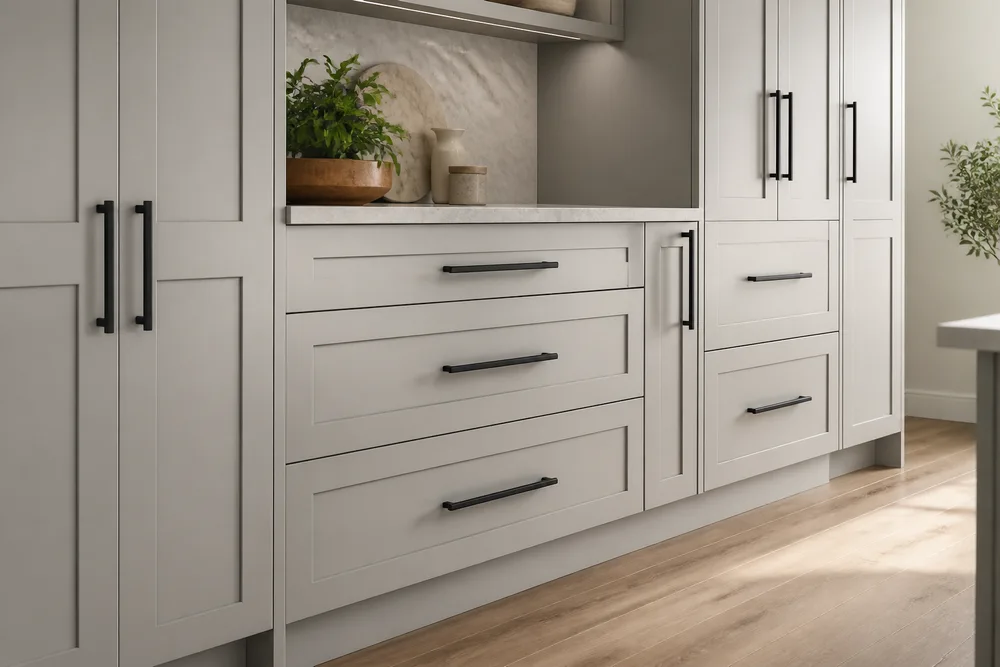
Black handles on gray cabinets create a distinct outline, especially on light gray slab and shaker doors. This route suits kitchens where the hardware is meant to be visible from across the room, or where black lighting, faucet, or appliance details already establish a dark accent.
The trade-off is clear: strong contrast makes inconsistent pull placement easier to spot. It can also make a small kitchen feel busier if the door layout already has many rails, panels, or exposed appliances. Confirm the pull positions before drilling or factory preparation; a crisp black line draws attention to small alignment errors.
Nickel and brushed brass for softer or warmer balance
Nickel cabinet pulls for gray cabinets usually offer a quieter transition than black. They can work well with cool or neutral gray doors when you want the cabinet detail to remain present without becoming the dominant contrast. Brushed brass hardware can bring warmth to greige or warmer gray cabinetry and can help prevent the room from reading overly cool.
Neither finish is automatically right. Brass may compete with other metal finishes if the kitchen already includes prominent chrome or black fixtures. Nickel can look too close to certain pale gray doors if the goal is strong definition. Ask to compare finish samples against the cabinet, countertop, and any fixed metal elements before final approval.
Match Handle Form to Cabinet Door Style and Everyday Touchpoints
Handle shape affects both the appearance of the cabinet and how it is used. Modern hardware for gray shaker cabinets often relies on straightforward bar pulls or restrained knobs because the door profile already supplies visual detail. Flat slab doors can support a similarly minimal pull, while a more decorative form may suit a traditional door treatment.
Do not choose by appearance alone. Think about the doors opened most often: trash pull-outs, pantry doors, refrigerator surrounds, and deep drawers. A handle that looks proportionate on an upper door may feel awkward on a wide, frequently used drawer. Check how the hand approaches it and whether the pull projection conflicts with nearby doors, walls, or appliance handles.
- Use a consistent form family across the visible kitchen faces.
- Set a clear rule for knob versus pull use before the order is released.
- Review handle length and mounting-hole requirements against each door and drawer front.
- Keep clearance checks in the brief for corners, tall units, and appliance panels.
These are installation decisions, not decoration details. Missing them can lead to on-site changes after doors or fronts have already been prepared.
Specify Functional Hardware Separately From Visible Pulls and Knobs
Visible pulls and knobs are the touchpoints on the cabinet face. Functional hardware is the working equipment behind it. They belong in the same kitchen plan, but they should not be treated as the same item category.
Drawer slide, lift-up, and storage systems
J&S Household identifies drawer slide systems, lift-up systems, and kitchen storage systems within its kitchen hardware range. Each should be selected against the cabinet application and the requirements of the project. A lift-up door has different clearance and motion considerations from a standard hinged door. A drawer slide choice depends on the drawer construction, intended contents, and the movement expected by the buyer. Storage components must fit the cabinet configuration they are intended to serve.
The supplied gray hardware information does not list product-level specifications for these systems. That is a reason to ask for the relevant details, not to assume them from a photograph or a broad category name. A matching hardware inquiry for gray cabinets should identify the cabinet type, door or drawer application, visible finish requirements, and any project documentation that governs the order.
Adjust the Hardware Brief for Single Kitchens, Multi-Unit Projects, and Resale Programs
A homeowner choosing one kitchen can spend more time comparing a few finish and handle samples in the room. The main risk is a choice that looks good alone but clashes with the cabinet undertone or daily use points.
For a builder or developer, repeatability becomes the priority. The brief should identify the approved cabinet finish, handle model or approved equivalent, placement rules, quantities by unit type, and the process for substitutions. One unanswered change can multiply across apartments or houses.
Wholesalers, retailers, and distributors need a sellable assortment with clear boundaries. Separate visible styles by their intended gray cabinet looks, then keep the functional component requests tied to the cabinet constructions and programs they support. This makes it easier to avoid presenting a decorative pull as if it answers a storage or drawer-motion requirement.
J&S Household states that it serves builders, developers, wholesalers, retailers, distributors, project partners, and end users, with loose-panel and assembled shipment workflows. Shipment format should be part of the early conversation because it affects how cabinet and hardware packages are planned and checked.
Bring a Clear Cabinet-and-Hardware Brief to J&S Household
J&S Household manufactures and exports kitchen cabinets, cabinet doors, flat pack base, wall, and tall units, plus kitchen hardware categories. Bringing the cabinet and hardware request together gives the supplier a clearer basis for reviewing the application, packaging approach, and quote.
Details to confirm before pricing and shipment
- Gray cabinet finish and a physical or approved finish reference.
- Visible hardware finish, form, intended placement, and quantity by cabinet or unit type.
- Cabinet door and drawer styles, including any shaker profiles or slab fronts.
- Required drawer slide, lift-up, and storage applications, with project requirements stated separately from decorative hardware.
- Loose-panel or assembled shipment preference, plus the destination and project schedule.
- Any required panel compliance or certification documentation for the cabinet scope; confirm applicability rather than assuming it applies to every hardware item.
Start your cabinet-and-hardware discussion with J&S Household gray kitchen cabinets hardware and bring the finish samples, cabinet list, and use-case notes that will shape the actual order.